Eidmi (ED-mee)
AI law firms can use without sending client data to a public cloud.
Leverage AI without routing client work through a public cloud.
Own My Firm's AI
Request a demo.
Tell us how big your firm is.
We'll identify the best fit.
The Default Trap
Cloud AI is a malpractice risk. Ignoring AI is a growth risk.
You're told to choose between enterprise cloud platforms like Harvey AI that extract over $432,000 a year from a 30-person firm,1 or consumer-grade AI that introduces severe malpractice risk. You don't need another per-seat cloud subscription that punishes you for growing. You need a fixed asset your firm owns.
1 Based on reported Harvey AI enterprise pricing of ~$1,200/seat/month × 30 attorneys × 12 months. Figures from public reporting; confirmed via scoping.
Day One Capability
Workflows your firm runs from day one.
Eidmi ships with capabilities tailored to your firm. Each runs on your firm's hardware, behind your firewall. Pick a workflow to see what your team does on day one.
How It Works
Turn your documents into Legal AI that writes like your firm.
Eidmi installs a private AI server inside your firm, then locally feeds it the contracts, briefs, and memos your team has already written. The system studies the work your firm already trusts, resulting in new drafts in your format, your tone, and your legal style - without a single file ever leaving your office.
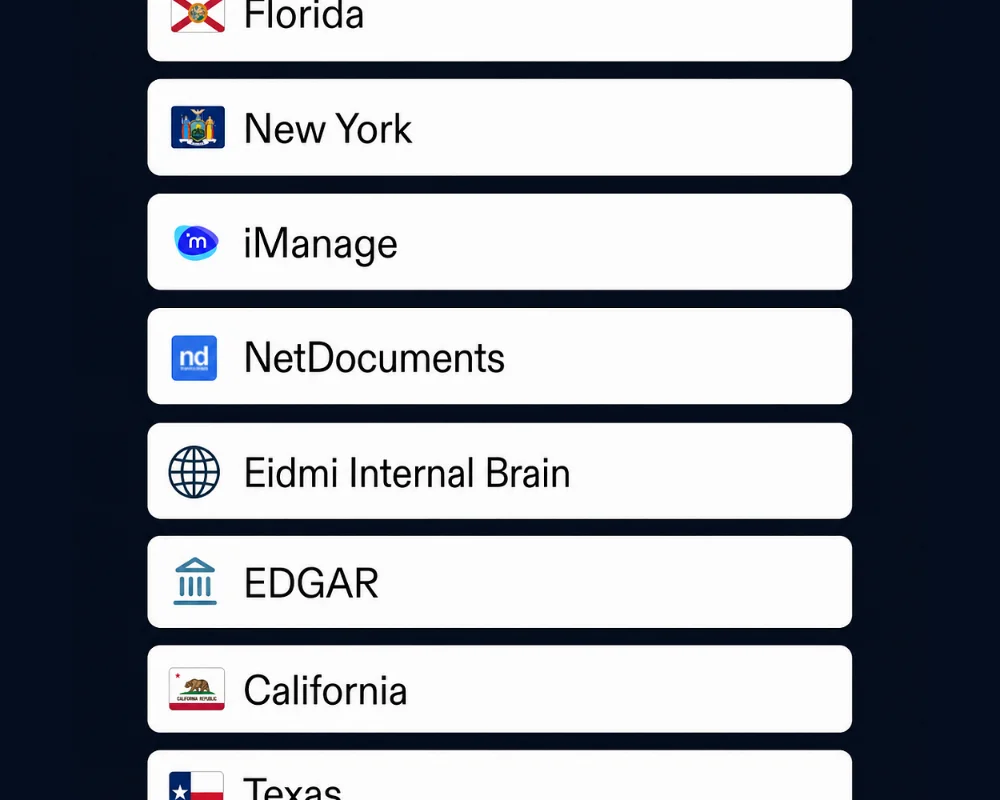
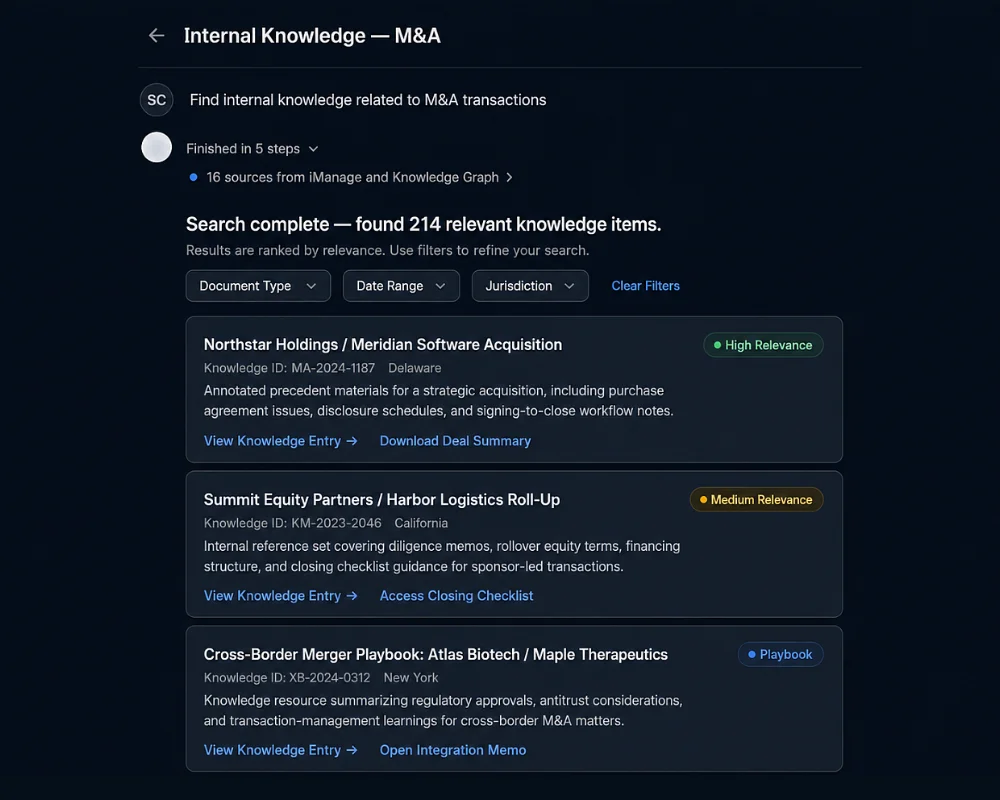
- The Internal Brain: Indexes your iManage, NetDocuments, or local case history without a single file leaving your firewall.
- The Open-Law Brain: 20M+ pre-loaded data points across federal statutes, SEC filings, and regional case law - no LexisNexis paywall.
- The Secure Gateway: Toggleable web search that scrubs client identifiers before querying the public internet.
The Private AI Asset
Law Firms Actually Own
This isn't another software subscription. It is a private AI asset your firm controls,
your attorneys can use, and your business actually owns from day one.
What You Get
Hardware
[ INCLUDED ]
Seats
[ 25 CONCURRENT USERS ]
Installation
[ WHITE-GLOVE ]
Data Cleanup Pipeline
[ LOCALIZED ]
Model Updates
[ BI-ANNUAL ]
Native DMS Integration
Replaces ~$15,000 in custom API development.
[ TURN-KEY ]
Open-Law Case Law Database
Displaces ~$30,000/yr in proprietary legal databases.
[ PRE-LOADED ]
Secure Web-Scraping Gateway
Zero-risk public queries with scrubbed client identifiers.
[ ISOLATED ]
Pricing Options
3-Year financed ownership path
[ $7,000 / month for 36 months ]
One-time payment path
[ $175,000 ONCE ]
Estimated after-tax cost
[ ~$110,250 AT 37% ]
Choose the financed path and your firm pays a fixed monthly amount for 36 months, then owns the system outright. Choose the one-time path and your firm owns the asset from day one.
Note
Final pricing for the Custom build is confirmed during scoping.
PRIVATE DEPLOYMENT APPLICATION
What You Get
Strategic Additions
Native DMS Integration
[ TURN-KEY ]
Replaces ~$15,000 in custom API development.
Open-Law Case Law Database
[ PRE-LOADED ]
Displaces ~$30,000/yr in proprietary legal databases.
Secure Web-Scraping Gateway
[ ISOLATED ]
Zero-risk public queries with scrubbed client identifiers.
Pricing Options
Choose the financed path and your firm pays a fixed monthly amount for 36 months, then owns the system outright. Choose the one-time path and your firm owns the asset from day one.
Final pricing for the Custom build is confirmed during scoping.
Assumes a full first-year deduction under IRS Section 179 / 100% bonus depreciation at your selected rate, whether you pay cash or finance. This is a federal deduction; state treatment varies. Illustrative estimate only — not tax advice. Confirm with your tax advisor.
Side By Side
They keep the asset.
They keep the asset.
Your firm foots the bill.
Compare what a cloud subscription costs over three years against a private deployment your firm controls, uses, and eventually owns outright.
Cloud-based AI
like Harvey AI
Eidmi Practice Tier
★ Recommended for you
Eidmi Firm tier (baseline)
Sized to your firm — you own the asset at the end.
★ Recommended for you
Pricing model
Per-seat subscription
One-time or financed ownership
One-time or financed ownership
Option 1: One-time cost
—
$95,000 one-time
$175,000 one-time
Estimated after-tax cost‡
—
$59,850
$110,250
Option 2: Financed (36 months)
—
$3,200/month
$7,000/month
Year 1 cost
$432,000
$38,400 financed
$84,000 financed
3-year cost
$1,296,000
$115,200 financed
$252,000 financed
Capacity
Per-seat scaling
Up to 10 concurrent users
Up to 25 concurrent users
Where data lives
Vendor cloud
Your office
Your office
Ownership at end
Nothing
You own the asset
You own the asset
Per-seat fee for new hires
Yes — every hire adds a monthly bill
None
None
Air-gapped capable / no cloud APIs
No
Yes
Yes
Bar-association exposure
Your data shares the same environment as everyone else's
Client data stays inside your firewall by default
Client data stays inside your firewall by default
Native DMS integration
Custom build required (~$15,000 in custom dev)
Included (turn-key)
Included (turn-key)
Case-law database
Add-on subscription (~$1,000 / user / month for LexisNexis-class tools†)
Included (Open-Law database)
Included (Open-Law database)
Localized historic data ingestion
Not offered
Included (white-glove pipeline)
Included (white-glove pipeline)
Cloud-based AI
(like Harvey AI)
Eidmi Firm tier (baseline)
★ Recommended for you
★ Recommended for you
Pricing model
Per-seat subscription
One-time or financed ownership
Option 1: One-time cost
—
$175,000 one-time
Estimated after-tax cost‡
—
$110,250
Option 2: Financed (36 months)
—
$7,000/month
Year 1 cost
$288,000*
$84,000 financed
3-year cost
$864,000*
$252,000 financed
Capacity
Per-seat scaling
Up to 25 concurrent users
Where data lives
Vendor cloud
Your office
Ownership at end
Nothing
You own the asset
Per-seat fee for new hires
Yes — every hire adds a monthly bill
None
Air-gapped capable
No
Yes
Bar-association exposure
Your data shares the same environment as everyone else's
Client data stays inside your firewall by default
Native DMS integration
Custom build required (~$15,000)
Included (turn-key)
Case-law database
Add-on (~$1,000/user/mo†)
Included (Open-Law database)
Localized data ingestion
Not offered
Included (white-glove pipeline)
* Midpoint of industry-typical range (±20%).
‡ After-tax figure assumes a full first-year IRS Section 179 / 100% bonus depreciation deduction at your selected rate (default 37%), cash or financed. Federal deduction; state treatment varies. Illustrative only — not tax advice.
Final pricing for the Custom build is confirmed during scoping.
* The comparison table anchors on the Firm baseline SKU. Larger firms step up to Firm Plus, Firm Pro, Firm Max, or Custom — the Cost Analyzer in the section above resolves the sized recommendation from your headcount.
† LexisNexis-class case-law database pricing reflects publicly reported per-seat add-on rates for cloud AI legal tools like Harvey AI; actual pricing depends on the vendor's contract.
‡ After-tax figures assume a full first-year deduction under IRS Section 179 / 100% bonus depreciation at the marginal rate selected in the Cost Analyzer above (default 37%), whether you pay cash or finance. This is a federal deduction; state treatment varies. Illustrative estimate only — not tax advice. Confirm with your tax advisor.
Ready to see the numbers for your firm?
Own My Firm's AIRequest a demo.
Included with every deployment
Eidmi Care
Every Eidmi deployment ships with Eidmi Care Standard.
-
3-year full hardware coverage
Every component on is covered for the full three years. No surprise replacement bills, no pro-rated parts fees.
-
5-business-day on-site replacement SLA
If a covered component fails, a replacement is on-site inside five business days.
-
Bi-annual model-stack upgrades
Your firm owns the hardware and keeps getting the newer models as they ship.
-
24/7 remote diagnostics
The system provides home telemetry (no client data, ever).
Eidmi Care Standard is the default that ships with every Practice, Firm baseline, Firm Plus, Firm Pro, Firm Max, and Custom deployment. Eidmi Care Premium (24-hour hot-spare swap + on-site technician dispatch inside 48h + optional 5-year extension) is available as a separate add-on during scoping.
Why A Waitlist
We deploy physical servers, not logins.
Every deployment requires physical hardware, white-glove installation, and real engineer time inside the firm's environment. That means we can only onboard a limited number of law firms each month, and the application is how we decide who fits the next installation window.
Questions partners ask before joining the waitlist.
No. We push the latest frontier AI models directly to your private server twice a year, so your firm gets better software without having to buy a new box every year.
You don't need them. The deployment model is white-glove. An engineer installs the hardware, boots the system, and initiates the localized data pipeline so your firm does not have to stand up the stack alone.
Yes. Firms that want ongoing support can keep Eidmi involved after deployment so your team does not have to manage the system alone.
The system securely reads your firm's past contracts, briefs, and memos, learning your exact formatting, style, and legal arguments. It uses your past wins as its textbook.
We review your application, confirm whether your firm is a fit, and decide whether there is room in the next installation cohort. This is a real deployment pipeline, not a generic newsletter signup.
No, and you won't need it to. Cloud AI tools force you to pay for expensive proprietary database plugins. We take a different approach. Your Eidmi server comes pre-loaded with the Open-Law Brain, a continuously updated, locally hosted vector database of US case law, SEC filings, and federal statutes. You get the citations you need to draft accurate briefs, without the proprietary SaaS paywalls.
Their business model depends on renting forever. Cloud AI companies earn more every time you hire another attorney — another seat, another monthly bill, another renewal. A one-time, fixed-cost asset that your firm owns is the opposite of that model. Eidmi is built around ownership on purpose.
No. Cloud AI vendors improve their products by pooling traffic, usage, and feedback across every customer. Eidmi is built to keep your firm's work inside your own walls — the system running on your hardware is yours. Nothing gets centralized into a shared cloud.
No. Mid-sized firms should not have to build an AI ops team. Deployment is white-glove: the hardware is installed, configured, and brought online for you. Ongoing health checks are available through Eidmi Care so your team does not have to manage the rack.
It doesn't start blank. Generic cloud AI starts without any knowledge of how your firm drafts. Eidmi is trained on the contracts, briefs, and memos your firm already trusts, so the system reflects your own standards instead of generic internet output. Your archive is the advantage.
Yes — and it's your call. The server ships air-gapped by default (wired-only, no internet routing). Your IT lead decides whether to attach it to the firm LAN, expose it over VPN, or keep it isolated. We document each option's tradeoffs during scoping.
Next Step
Stop renting cloud software that puts your firm at risk.Own your AI.
Fill out the deployment application below to see if your firm qualifies for one of our remaining installation slots.
Request a demo.